The GreenSkills4VET partnership meets in Portugal
04.06.2024
Testimonial pathways & teaching cases
We have successfully finished Work Package 2!
The students of the 4 vocational training centres of the Partnership have visited leading companies in their respective sectors, learning more about sustainability practices. Through the visits to companies, we were able to analyse, select and transfer to the VET field the main problems of environmental sustainability affecting the companies involved in the project, which are representative of sectors with a high impact on the environment (Agri-Food, Mechanics, Textile-Fashion, Logistics).
The companies involved in the Partnership have also visited the vocational training centres and have conducted workshops with the students. All training centres have designed the teaching/training cases on environmental sustainability, in coherence with the curricular learning objectives of the study course.
Project's next steps
In the coming months, the students will be busy responding to the challenges launched by companies, putting the skills acquired into practice. In Italy, one of the sustainability challenges posed by the company is to reduce refrigerant process impact on the environment. Students are working in groups to research on new ecologic refrigerant fluids with characteristics of sustainability, safety and low impact on the environment. They are also analysing energy saving on the system (gas recover, avoid using too water to cool the system) as well as solutions to carbon free target.
In Croatia, the sustainability challenge launched by the company is the transition from motorized to electric vehicles in capillary distribution. The students must find an adequate replacement of the existing vehicles taking into account the type of vehicle, load capacity, range of kilometers traveled in one charge, provision of charging points, and estimation of investment and savings.
In Portugal, the challenge is to find new ways to reorganize agrarian ecosystems and reduce the application of phytopharmaceuticals. Some insects can combat pests and help encourage pollination. The students are building hedges, herbaceous coverings and insect shelters in order to breed insects to replace pesticides
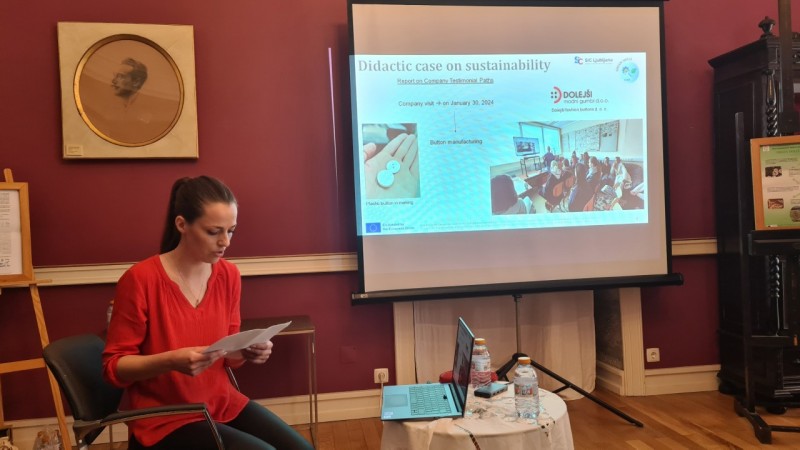
In Slovenia, the challenge is the waste generated during the production of buttons. How to generate value from this waste? How to convert this waste into a useful product? The students will use the plastic granules as a filler and are already working on prototypes of stuffed products that could be commercialized, such as a door stopper, a mousepad, a weighted blanket or an exercise roller.
Funded by the European Union. Views and opinions expressed are however those of the author(s) only and do not necessarily reflect those of the European Union or the European Education and Culture Executive Agency (EACEA). Neither the European Union nor EACEA can be held responsible for them.